
The catastrophe in Gaza will be remembered primarily for the mass killing by Israeli forces of Palestinian civilians. This horror, however, has been accompanied by another attempted erasure: the history and culture of an ancient urbanised region has been ruthlessly attacked.
Gaza was a trade route and an important component of East Mediterranean civilisation from before the Christian era and contained many physical reminders of human settlement and political change, particularly since the time of the Romans.
When I visited Gaza in January 2013, I was drawn as an historian to these historical and archaeological artefacts. The old gold market, the Roman remains, the medieval fragments.
Among other historical excursions, I dropped by the interesting Qasr al-Basha museum (“Napoleon’s Fort“). Unfortunately, since late 2023, Israel has mercilessly annihilated what previous centuries couldn’t. Here is what I read recently about the current status of ‘Napoleon’s Fort’:
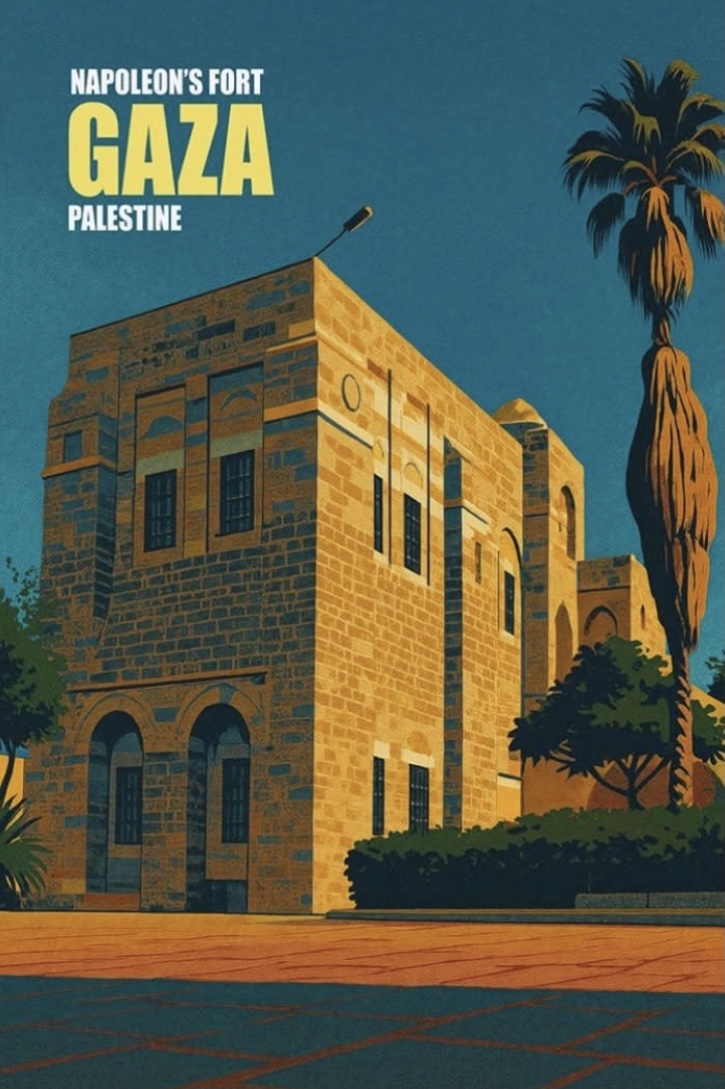 Unfortunately, since late 2023, Israel has mercilessly annihilated what previous centuries couldn’t. Here is what I read recently about the current status of ‘Napoleon’s Fort’:
“‘Napoleon’s Fort‘ in Gaza, formally known as Qasr al-Basha (Pasha’s Palace), was heavily damaged during the conflict, with over 70% of its structures reduced to ruins. Prior to its destruction, the 13th-century medieval fortress served as a museum in the Old City of Gaza, famously hosting Napoleon Bonaparte for a brief stay in 1799.”
This is not a singular event. Historical buildings, including mosques and Christian churches, have been destroyed or damaged throughout Gaza. No respect has been shown to what has gone before. Israel wishes to remake Gaza in its own image.
For additional information on the destruction of historical artefacts in Gaza, click https://www.capradio.org/news/npr/story?storyid=1226295081
.